“For the wages of sin is death; but the gift of God is eternal life through Jesus Christ our Lord.” — Romans 6:23
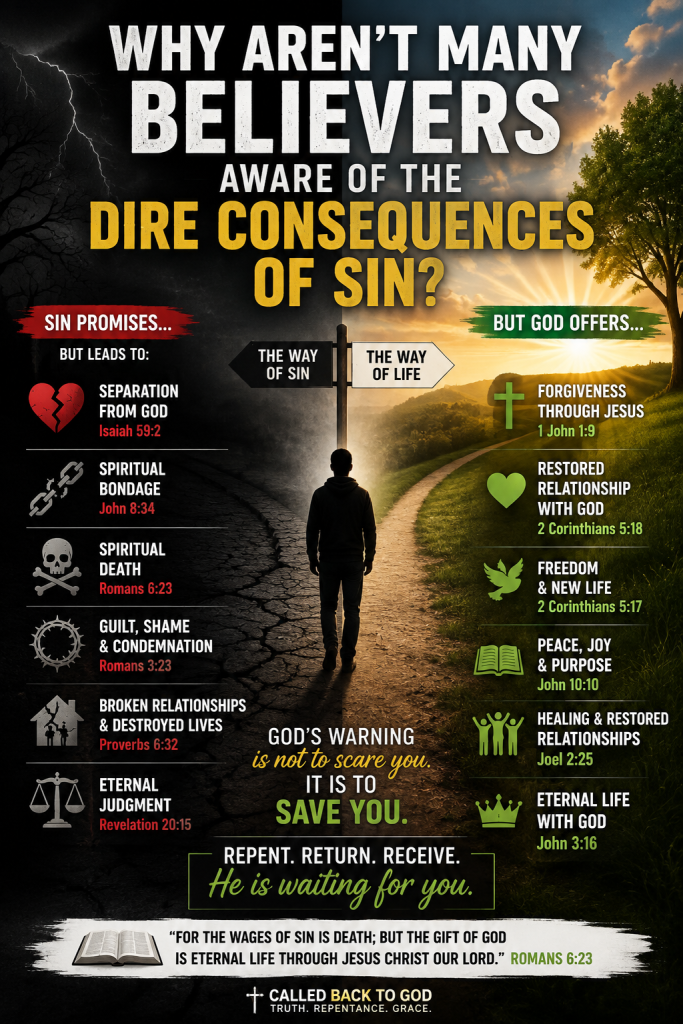
We live in a time when the word sin can make even Christians uncomfortable. Messages about blessing, purpose, success, healing, and encouragement are often welcomed, but conversations about repentance, holiness, judgment, and the consequences of sin can be much harder to hear.
Yet Scripture never treats sin casually.
From Genesis to Revelation, the Bible shows us that sin destroys, separates, deceives, enslaves, and eventually produces death. So why do many believers today seem unaware of—or unconcerned about—its consequences?
1. Sin Has Become Normalized
When we are repeatedly exposed to something, we can gradually stop being disturbed by it.
Behaviors that once troubled our conscience may begin to seem normal when they are constantly celebrated by society, entertainment, social media, friends, or even other Christians.
Hebrews warns:
“But exhort one another daily… lest any of you be hardened through the deceitfulness of sin.” — Hebrews 3:13
Notice that Scripture calls sin deceitful.
Sin rarely shows you where it will eventually take you. It shows you the pleasure, satisfaction, opportunity, or justification of the moment while hiding the consequences.
The more we excuse sin, the easier it becomes to excuse it again.
Eventually, what once convicted us may no longer bother us.
2. Grace Is Sometimes Taught Without Repentance
God’s grace is one of the most beautiful truths of Christianity. We are not saved because we are perfect. We are saved by grace through faith in Jesus Christ.
But grace was never intended to become permission to continue deliberately living in sin.
Paul confronted this thinking directly:
“Shall we continue in sin, that grace may abound? God forbid.” — Romans 6:1–2
Biblical grace doesn’t merely forgive us; it transforms us.
Titus 2:11–12 teaches that the grace of God trains us to reject ungodliness and worldly desires and to live godly lives.
A message that talks about forgiveness but never talks about repentance gives people an incomplete picture of the Gospel.
3. We Confuse Forgiveness With Freedom From Consequences
This is extremely important.
God can forgive a sin while consequences from that sin remain.
David is a powerful example.
After his sin involving Bathsheba and Uriah, David genuinely repented. He confessed:
“I have sinned against the LORD.” — 2 Samuel 12:13
God forgave him.
But David still experienced devastating consequences in his family.
The same principle can operate today.
A marriage can be damaged by adultery.
A ministry can lose credibility because of hidden immorality.
A friendship can be destroyed through betrayal.
A family can suffer because of addiction.
A person’s testimony can be severely damaged through years of hypocrisy.
Forgiveness is real—but forgiveness does not necessarily erase every earthly consequence of our decisions.
4. Sin Gradually Hardens the Heart
One of the most dangerous consequences of persistent sin is not merely what happens around us.
It is what happens inside us.
A person may initially feel strong conviction after doing something wrong. But if they continually ignore that conviction, justify their behavior, and refuse to repent, their heart can become increasingly hardened.
That is why Hebrews 3:13 warns about becoming “hardened through the deceitfulness of sin.”
The frightening thing about spiritual hardness is that a person may eventually become comfortable with something that once brought them to tears.
5. Some Churches Rarely Talk About Sin
Churches should certainly preach hope.
We should preach God’s love.
We should preach grace.
We should preach restoration.
But we cannot faithfully preach the Gospel while removing repentance from the message.
Jesus Himself preached:
“Repent ye, and believe the gospel.” — Mark 1:15
Jesus loved sinners deeply, yet His love never required Him to pretend that sin was harmless.
A church that tells people only what comforts them may attract crowds, but it may fail to prepare people for genuine discipleship.
Sometimes love must warn.
6. We Have Forgotten What Sin Actually Cost
Perhaps one reason we sometimes treat sin lightly is because we forget the cross.
The crucifixion demonstrates both the seriousness of sin and the magnitude of God’s love.
Jesus didn’t die because sin was insignificant.
Christ gave Himself so that sinners could be reconciled to God.
The cross should therefore produce two responses within us:
Deep gratitude for God’s grace and a deep desire not to return to the bondage from which Christ rescued us.
The Purpose of Conviction Is Restoration
Talking seriously about sin should never become an excuse for Christians to become self-righteous.
We don’t warn people about sin because we believe we’re better than them.
Every one of us needs God’s mercy.
Romans 3:23 declares:
“For all have sinned, and come short of the glory of God.”
The purpose of conviction isn’t hopeless condemnation.
It’s an invitation to return.
When God reveals something wrong in our lives, His desire is not merely to shame us. He calls us to confess, repent, receive His mercy, and walk differently.
First John 1:9 gives us this wonderful promise:
“If we confess our sins, he is faithful and just to forgive us our sins, and to cleanse us from all unrighteousness.”
Don’t Wait Until Sin Shows You Its Final Price
Sin will always promise more than it ultimately gives.
It can offer pleasure while hiding bondage.
It can offer freedom while producing slavery.
It can offer secrecy while eventually bringing exposure.
It can offer temporary satisfaction while leaving lasting consequences.
That is why God’s warnings about sin are not evidence that He wants to deprive us of life.
They are evidence that He wants to protect us from what destroys life.
If there is something God has been convicting you about, don’t continually silence that conviction.
Return to Him.
Repent.
Receive His mercy.
And walk again in obedience.
Because God’s message is not simply:
“You have sinned.”
His invitation is:
“Come back to Me.”

Engagement question:
Do you think Christians today understand how serious the consequences of sin can be—or has sin become too normalized in the church?
Called Back to God
Calling hearts back to truth, repentance, and a genuine relationship with God.